

I wanted to be Anthony Bourdain—until I met him.
CW: suicide, suicidal ideation, addiction

Today is my birthday. It is also Anthony Bourdain’s birthday. The man was one of my heroes and in honor of our shared DOB (and ahead of the new A24 biopic), I am re-releasing an old post about when we met. Thanks for reading!
I sat in front of a blank Word Doc on the patio of my corner coffee shop, sweating and chain-smoking Marlboro Reds. Anthony Bourdain had been found dead that morning and I was supposed to have something to say about it. I knew I did, but as acidic smoke plumed blue in my face, my fingers faltered over my keyboard.
What did I have to say about the man? I had only talked to him twice. I felt inadequate as I pieced together a eulogy about what he had meant to me and millions of others. As I typed, I kept the cigarette lit between my lips so if anyone saw me, I could say that I wasn’t crying, my eyes were just filling with smoke.
Finally, I sent the article to my editor and exhaled, hoping my words conveyed something (anything) about my relationship to Bourdain. But after I returned to my apartment, I could no longer pretend to hold myself together. I collapsed in tears and my roommate burst out of her room, asking, “What’s wrong?”
“Bourdain,” I sputtered, well aware I shouldn’t be sobbing over a man I had only spoken to twice.
She put her arm around me, puzzled. Throughout our friendship, I’d had the reputation of being the stoic one. “It’s always so confusing when people do something like that,” she said, trying to console me.
“I’m not crying because I’m confused,” I wiped away tears with the heels of my hands. “I’m crying because I understand. I understand it completely. And I’m scared.”
Whenever people asked how I became a travel writer, I’d smile and shrug with something like, “Oh, I just kinda fell into it.” But the real answer was: I wanted to be Anthony Bourdain.
As a teenager, I was enamored. He was cool. And smart. And funny. He knew about books. And movies. And music. He was a rock star in a foreign correspondent’s body—or was it a foreign correspondent in a rock star’s body? After watching “No Reservations,” I knew exactly the type of adult I wanted to be: one who, like Anthony Bourdain, wasn’t like other adults. I wanted to swear like Bourdain. I wanted to live like him. And fucking Christ, did I.
When Bourdain died, I was a 24-year-old travel writer who had traveled to Paris, Puerto Rico, and Montreal all within a month. I was dating a guy who did heroin. And I’d been suicidal—on and off—for years. The sort of suicidal that masked as a hard-partying lifestyle. People who only saw me at night would call me things like “free-spirited.” But it’s easy to be free-spirited when you don’t care if you live or if you die.
On the road, this manifested as “Bourdain style” travel. That meant, namely, binge-drinking on press trips but also getting on the backs of strangers’ motorcycles in foreign countries and walking deep into medinas alone, hoping I’d find some Burroughs shit. (All I got was lost.) I went to clubs on a mission to erase my mind. I would go anywhere with anyone because I didn’t care if I made it back home. (Somehow, luckily, I always did.)
Lots of people loved Bourdain, but I think his most ardent fans were fellow addicts. He wrote openly about his heroin use and early debauchery. He often said he was stunned that he was still alive.
In my early 20s, I never thought much about this part of his life, other than to acknowledge that it made for great lore. I didn’t recognize my own patterns of addiction. All I knew was that Bourdain burned bright, which encouraged me to burn brighter. What I didn’t recognize was that a burning person must always be burning something. Every fire needs some fuel.
A year before Bourdain’s death, I was shaking at my kitchen table as I dialed the number his publicist had given me. When the hotel’s front desk picked up, I collected myself and repeated the room number I’d been told.
They patched me through and a deep voice answered, “Hello?”
“Is this Anthony Bourdain!?” I practically shouted.
“Yes..?” he answered tentatively. I melted in my chair, glad he couldn’t see my nerves.
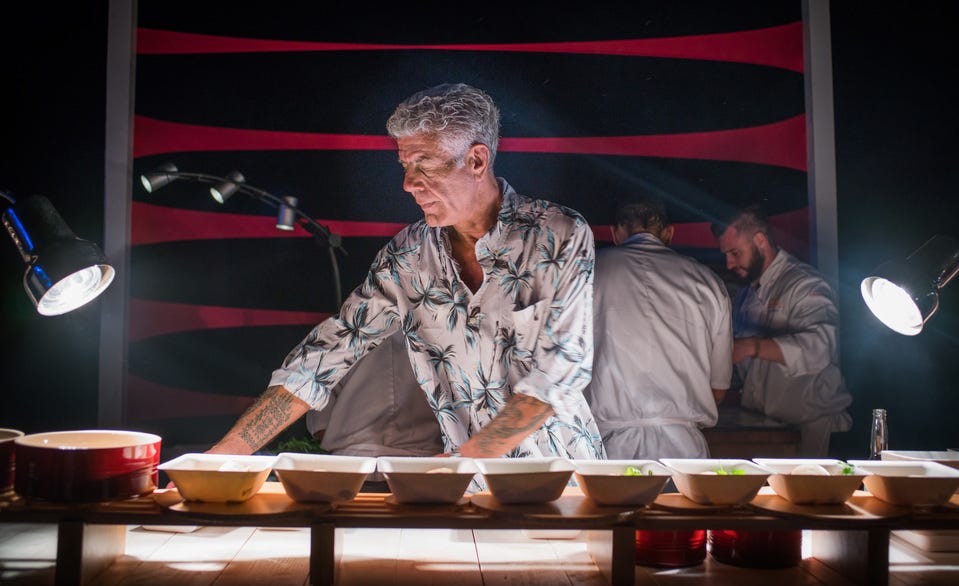
I went down a list of questions my editor had given me—packing tips, his favorite foods, favorite vacations. Things that made for strong headlines. Bourdain answered politely but half-heartedly, like a musician playing the Greatest Hits he’d long since stopped caring about.
Finally, I asked him about West Virginia, where he was filming at the time. What was it like there? His voice changed, becoming both more thoughtful and more animated. He told me that he’d sat down with war criminals around the world and shared meals with people he vehemently disagreed with. Why couldn’t he do the same in his own country? He was learning about the complexity of West Virginians, despite their simple reputation of “Trump, guns, and football.” He told me about their long-standing (and justified) distrust of the government. He told me how he was developing a better understanding of America by being there.
I listened in awe, newly convinced of the necessity for curiosity about places you think you know. I had glimpsed something of Bourdain that felt more true than the laughs and the wise-guy voiceovers or the excess. After about a half-hour, I hung up the phone, convinced that whoever said you shouldn’t meet your heroes must have had some shitty heroes.
A few months before his death, I was in Morocco, a country I had dreamed about visiting for years. I had walked around the medina alone and eaten goat’s brain cooked in its skull and I stared out over the Atlas Mountains and I felt—nothing. I walked around a market in a small town and bought melon slices that a vendor was offering.
I had smiled and said something in French and still—nothing. The fast life always slows down, but not how you’d expect. After enough time, you just get used to the pace, then it doesn’t seem so fast.
The next day, I spent the entire afternoon curled up at the base of the porcelain throne, praying for salvation from the unwashed melon. I was going to stop doing drugs, I told myself. Nothing was worth the panic of a comedown. But every time I had said that before, I’d called my dealer that Friday night. At least I had the sense to realize that going to different countries wasn’t a solution to a life.
I had stopped being able to outrun my problems. Eventually, life on the road just becomes regular life. Whereas most people escape for adventure, when you’re a travel writer, you start craving an escape to stability. But people keep telling you that you have a dream job.
With my head over the toilet, I came up with a plan to kill myself. It wasn’t about the fruit. It was about the fact that I was living out my dreams and I couldn’t feel anything. Life was meaningless and I saw only one way out. I was going to get a gun. I wasn’t going to leave a note.
About six weeks before he died, I waited for Bourdain at a German restaurant on the Upper West Side. I had arrived before him, which was rare, his publicist told me. “Tony is almost always early,” she said. I sat in the dark restaurant while the film crew set up lights and cameras. Then the heavy, wooden door swung open and a large 6’4” frame strode in. I had never seen anybody actually walk into a room like a cowboy. He said, “Hello,” in a voice so deep and gravelly, it was almost cartoon.
As he sat down across from me, he was kind, albeit distracted and uncomfortable. But that was fair. He was at the restaurant to film, and I think the only people who are fully comfortable with journalists are almost always narcissists.
A few months had passed since my phone interview and this time, I didn’t have to ask my editor’s questions. So I asked how he picked the music for his show. I asked about his film influences, about politics. I wanted to know how this man thought, not what he packed for a weekend trip.
The energy was instantly different. He was smiling and his voice was almost exuberant. He came alive when talking about other people’s work—Wong Kar-Wai, Bernardo Bertolucci, Christopher Doyle—but it was music that really seemed to animate him. As he talked about Brian Jonestown Massacre and System of a Down, his smile became a full-on grin. I nodded along, knowing his references mainly because he’d talked about them in episodes or on Twitter.
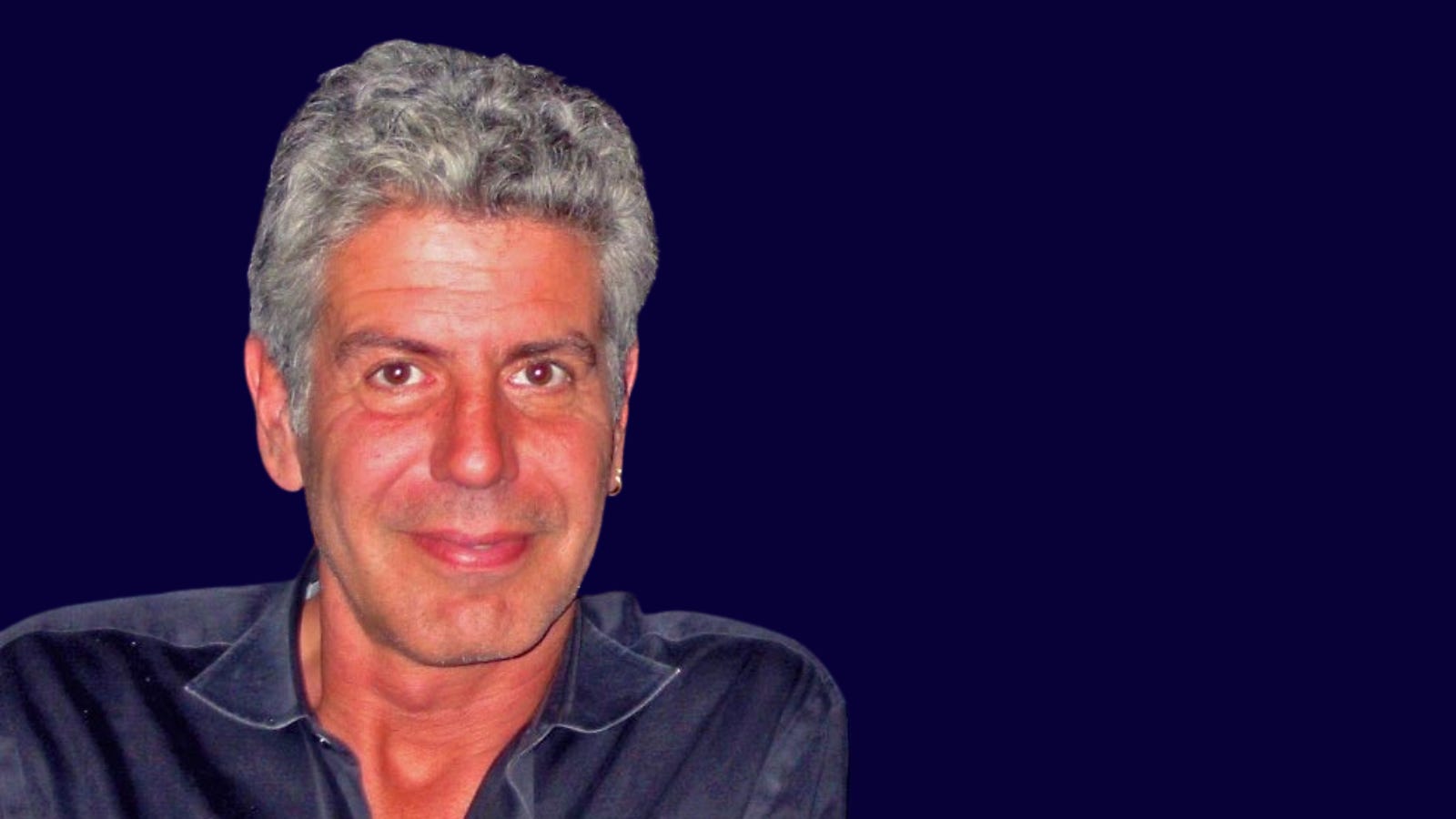

“Finally!” he smacked his palms against the wooden table. “Someone who gets it!”
I nearly melted in my chair again.
When I met Bourdain, I had precarious work. My boyfriend was on heroin. I’d stand at crosswalks, measuring how fast cars were going and when I could step out if I wanted them to hit me without swerving. I had this chronic sense that the world was empty, or at least just a battle that would always be impossible to win.
But I interpreted this one moment—to be branded by my teenage hero as “someone who gets it”—as the pinnacle of my life. Validation that I was doing something correctly. It didn’t enter my mind that perhaps what he approved was the way I had followed his path.
When we wrapped the interview, he smiled and shook my hand. He said he was looking forward to reading my piece. I was still dazed when his publicist came up and said Tony seemed to like me. Would I want to spend a day on set sometime soon?
There are many different episodes of “Parts Unknown” that people point to as their favorites. The one where he eats pho with Barack Obama in Hanoi. The one where he has to flee Lebanon as war breaks out.
Personally, I always return to the Miami episode, which aired three years before Bourdain’s death, where he gets lunch with Iggy Pop.
In an interview about the episode, Bourdain says of Iggy: “His music was incredibly important to me from early on. Responsible for—in many ways—many of the things that went wrong in my life.”
But when he gets to Miami, Bourdain finds a healthy Pop. At lunch, they share one glass of white wine each. Iggy orders the shrimp.
You get the sense that Bourdain has come to this interview as a pilgrim comes to their guru on top of a mountain. The duo sits near a window with Venetian blinds. The sun is shining.
“As far as looking after my health,” Bourdain starts, grinning, “your music early on was a negative example.”
“I hear you,” Iggy Pop looks down and smiles.
“And looking at my own life and career, I’m pretty much known for traveling around the world and recklessly drinking and eating to excess.” He’s incredibly animated as he speaks. “What does it say about us that we are now sitting in a healthy restaurant—I just came from the gym—and we’re in Florida?”
Iggy Pop takes a minute to answer, like he’s been searching himself with this same question. But he’s not tortured about it. His eyes are clear and blue and he looks directly at Bourdain.
“Listen, if you just flame out, you’re in such voluminous and undistinguished company. And then all your works will flame out quicker with you.”
Eerily, the YouTube clip freezes at this moment. You never see Bourdain’s reaction to his hero’s proclamation.
But if you keep watching the episode, there are a few clues about how Bourdain may have felt.
As Iggy keeps talking about simple pleasures, Bourdain’s Adam’s Apple jumps. His eyes jump around too as he asks his hero, “You’re the template for the rockstar. Other rock stars look to you to figure out ‘How should I behave?’ [...] Given that, what thrills you?”
Iggy smiles. “The nicest stuff right now, it’s really embarrassing,” he says, completely serene yet almost sheepish. “It’s being loved and actually appreciating the people that are giving that to me.”
And is it just me—or does Bourdain’s face fall?
In certain travel journalism circles, there’s this thing known as the “Bourdain Effect.” It’s what happens when a restaurant featured in his show becomes overrun with tourists, losing the very essence that once drew Bourdain to it. This kept happening to such a large extent that towards the end of his life, Bourdain was sincerely grappling with the ethics of what he was doing.
He had become agoraphobic. He began to visualize his ideal episode of Parts Unknown: he wouldn’t be in it, it would just be “his point of view, a camera moving through space.”
As I approached five years on the job, I also began grappling with the ethics of travel writing. I was beginning to see cities change. And quickly. The streets were more crowded. Residents were being pushed out for Airbnbs. Delis had become souvenir shops.
But I couldn’t forget what I had seen as a broke 19-year-old backpacker. People used to actually live in Venice. Machu Picchu wasn’t always ticketed. The Eiffel Tower was a maligned structure before it became a symbol.
We forget what places used to be. And I think we’re the same with people. When we meet a person in the throes of active addiction, we consider it their personality instead of a coping mechanism. We don’t think about the thing fueling their fire or the maladaptive patterns that are handed off like some great generational relay race.
By the end of his life, Bourdain was deeply aware of the damage tourism could do to places. I wonder whether he was equally aware of the damage mythology can do to people.
When he visited Haiti and saw the growing tourism industry, he directly asked locals, “Are we part of the problem?”
I do not think Bourdain was the problem, not in travel journalism and certainly not in my life. I do not hold him responsible for the myths he inherited, then passed on. I do not blame the man for decades (hell, centuries) of a culture that repeated sincerely and with conviction that it was better to burn out than to fade away. He was just a single point in the constellation of great pained people, and you can’t blame the North Star for shining brightest for you.
A few months after his death, I started going to therapy. I stopped doing hard drugs. But I never once contemplated quitting the thing that had defined my young adult life so far: travel writing.
I knew that I hated travel journalism, but I didn’t know what else to do. Everybody else thought I was living “the dream job” and I didn’t know how to tell them that I couldn’t stop thinking about walking into traffic.
A few months after his death, I moved to London. The guy I was dating left me for someone druggier. I boarded more trains. It took another year of vague dissatisfaction before I began to consider the possibility of leaving travel writing. Standing on the balcony at the Four Seasons Dubai, I looked out at the traffic blinking its way into the shiny city. And I couldn’t feel the difference between there and anywhere else. The cities had swirled into each other and I hated myself for it. Meanwhile, I kept getting assigned stories about celebrities and which suitcases they lugged to the airport.
Then the pandemic hit.
Almost immediately, I stopped traveling. Then the work stopped coming in. I found myself aimless—but what was strange to me was that I didn’t really mind.
I no longer wished to travel the world—not out of any lack of curiosity but because I no longer believed a perpetual tourist was the most interesting thing a person could be. Or rather, I had stopped believing that one could only be a tourist in certain hallowed locations.
I went back to my hometown and studied the faces of everyone I could find. I took trains and buses across America and stopped in small towns—Barstow, California; Stillwater, Oklahoma.
I wanted to be a tourist somewhere I thought I already knew. I became curious about being loved and actually appreciating the people giving that to me.
These days, I am trying to see myself and the people around me with tourist’s eyes. I try to remain curious, as if I’ve never seen any of this before. Though it may not have been his strategy, I know I have Bourdain to thank for that.
I still think of him quite a bit. Now, eight years after his death, when travel has slowed and I haven’t boarded a plane in a year, I find myself wondering what would happen if we could talk again.
Would we sit down in a dark, uptown restaurant? Would we talk about music? I don’t know. Though I know that I have new questions.
I would ask how it felt to meet his hero. I would ask the same question he asked Iggy Pop: given that you’re the template for the rockstar, what thrills you?
I wonder how he would respond. I wonder if my face would fall.
Find a crisis line in your country at findahelpline.com.
This is a really beautiful and moving piece. Thanks for giving it so much - it feels like you left nothing on the table.
A lovely piece. They say, “never meet your heroes” but that’s not quite right. Meet them with an open heart, and if you’re lucky they’ll intuit that and you’ll both be better off.